
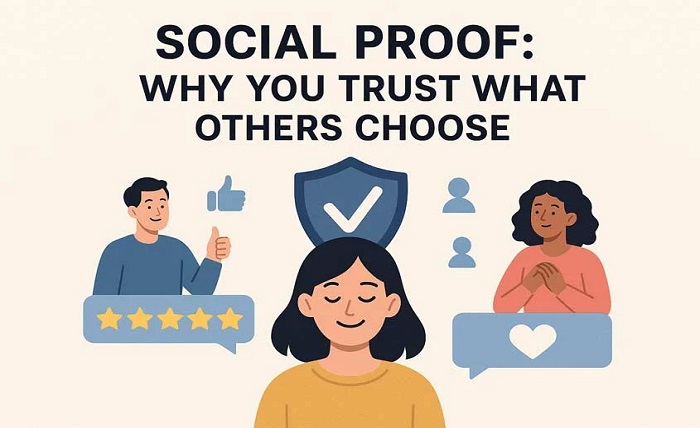
You are walking down an unfamiliar street, looking for a place to eat. Two restaurants stand side-by-side: one has a line out the door, and the other is completely empty. Without conscious thought, you join the back of the line. You have just outsourced your decision-making to strangers. This psychological shortcut is called social proof, and while it helps us quickly evaluate a dinner spot, its true power lies in how it dictates our heaviest, most permanent commitments. From the houses we purchase to the ways we manage our discretionary income, the invisible pressure of the crowd constantly shapes our personal reality. Recognizing how this psychological mechanism works is the first step toward reclaiming genuine autonomy over your life.
Why Do Bidding Wars Dictate Our Financial Limits?
The most obvious arena where social proof takes the wheel is real estate. Buying a home is ostensibly a mathematical decision based on interest rates, square footage, and budget constraints. Yet, the moment a buyer enters a highly competitive housing market, logic is quickly overridden by the actions of competing buyers.
When you attend an open house packed with other interested couples, a psychological alarm bell rings. The sheer presence of other people validates the property’s worth, often convincing buyers to stretch tens of thousands of dollars beyond their strict budgetary limits. We inherently assume that if a dozen other families are willing to bid on a specific house, they must possess some hidden knowledge about the neighborhood’s future value. This competitive validation creates a localized frenzy.
Real estate agents intentionally manufacture this social proof by tightly restricting viewing windows, forcing all potential buyers into the home at the exact same time. The resulting claustrophobia and visible competition accelerate the decision-making process, causing buyers to take extreme actions:
- Waiving vital inspections: Dropping important safety checks just to make their offer look more appealing to the seller.
- Ignoring original budgets: Writing massive checks that completely disregard their initial, pre-calculated financial limits.
- Bidding purely to win: Viewing the house as a scarce prize to be won against rivals, rather than a structure of wood and drywall.
How Does Community Validation Override Personal Risk?
Beyond standard investments, social proof heavily dictates how we approach leisure, especially when our entertainment involves direct financial stakes. We are incredibly protective of our money, yet we willingly spend it on unfamiliar websites and offshore servers—provided we see a crowd doing it first.
When exploring high-stakes entertainment, the psychological need for community validation skyrockets. We rarely trust a company’s marketing copy; instead, we look for verified actions taken by our peers. For instance, when registering at the new online casino Runa, a sensible player does not simply wire funds based on flashy graphics. They look for verifiable signs of life, such as:
- Active, public chat rooms filled with real-time player conversations.
- Live, scrolling tickers broadcasting recent jackpot winners across the screen.
- Detailed payout reports and honest reviews from real users on external message boards.
The presence of a vibrant, actively participating community serves as a psychological safety net. If thousands of other people are actively wagering and successfully withdrawing their funds, the primitive part of our brain determines that the environment is secure. This community consensus effectively replaces the physical trust we would normally demand from a brick-and-mortar establishment, allowing us to confidently engage in financial risk from the comfort of our living rooms.
Who Actually Chooses Your Career Path?
Perhaps the most insidious application of social proof happens within our professional lives. From the moment we enter university, we are subtly nudged toward career paths that carry high societal validation.
Think about the prestige associated with becoming a doctor, a corporate lawyer, or a software engineer at a major tech firm. These roles are highly coveted not just for their salaries, but for the immediate social respect they command at a dinner party. Many professionals wake up a decade into a grueling, high-stress career only to realize they chose their path based entirely on the applause of their peers rather than their own internal passions.
To understand how thoroughly we allow the crowd to dictate our lives, consider the specific triggers that push us toward major career choices:
- Title prestige: Chasing a job title simply for how impressive it sounds to family and friends.
- Salary optics: Prioritizing visible wealth markers—like a luxury car lease—over actual, day-to-day job satisfaction.
- Peer alignment: Committing to an industry solely because it is where all of your college friends decided to go.
Breaking the Illusion of Consensus
Wrapping up the conversation on social proof requires shifting our perspective on what it means to be successful. We are biologically wired to survive by staying with the herd, but modern society weaponizes this survival instinct against us. The crowd is not an omniscient entity possessing secret wisdom; the crowd is often just a collection of individuals who are all secretly looking at each other to figure out what to do next.
True independence requires treating social proof as a single data point rather than a strict directive. The next time you feel an overwhelming urge to enter a bidding war, change your career track, or follow a financial trend, pause and look at the room. Are you making the choice because the math makes sense for your specific life, or are you simply standing in line because everyone else is already there? Walking past the crowded restaurant to find your own meal is uncomfortable, but it is the only way to ensure you are eating exactly what you actually ordered.